

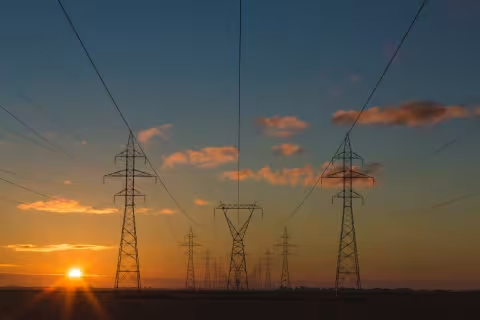
Sustainable Technology: Building Greener IT Infrastructure
The technology industry consumes roughly 10% of global electricity — projected to double by 2030. Organisations that embed green principles into their IT infrastructure today will reduce costs, meet regulatory demands, and future-proof against carbon-pricing mechanisms on the horizon.
The technology industry consumes roughly 10% of global electricity — a figure projected to double by 2030 as AI workloads, streaming, and cloud adoption accelerate. Sustainable technology is no longer an ethical nicety; it is a strategic imperative. Organisations that embed green principles into their IT infrastructure today will reduce operating costs, meet tightening regulatory demands, and future-proof themselves against carbon-pricing mechanisms on the horizon.
What Is Green IT?
Green IT (or sustainable technology) refers to the design, manufacture, use, and disposal of computing resources in ways that minimise environmental impact. The discipline spans hardware procurement, data centre operations, software efficiency, and end-of-life recycling. Unlike corporate social responsibility programmes that sit alongside core operations, Green IT must be woven into every architectural and procurement decision.
"The most sustainable kilowatt-hour is the one you never use. Efficiency must come before renewables." — Rocky Mountain Institute

Core Pillars of a Greener IT Infrastructure
1. Energy-Efficient Hardware
Modern servers, switches, and storage arrays vary enormously in energy efficiency. Specifying hardware with ENERGY STAR or 80 PLUS Platinum/Titanium power-supply ratings can cut idle consumption by 20–40%. Arm-based processors (AWS Graviton, Ampere Altra) deliver comparable compute throughput at 60% of the power draw of equivalent x86 chips for many workloads.
2. Data Centre Power Usage Effectiveness (PUE)
PUE is the industry-standard metric — total facility power divided by IT equipment power. A PUE of 1.0 is perfect; the global average sits near 1.58. Hyperscale operators routinely achieve 1.10–1.15 through hot/cold aisle containment, free cooling via outside air, and direct liquid cooling (DLC) on GPU-dense racks. For on-premises infrastructure, targeting PUE ≤ 1.30 is an achievable two-year goal for most organisations.
3. Cloud Migration and Right-Sizing
Public cloud providers operate at massive scale, allowing them to distribute workloads across far fewer, far denser servers than a typical enterprise data centre. Migrating a mid-market application portfolio to a hyperscaler can reduce associated carbon emissions by 65–80%, according to Accenture and AWS studies. Critically, right-sizing — matching instance type and size to actual workload demand — prevents the cloud from simply replicating on-premises over-provisioning in a new location.
4. Renewable Energy Procurement
Power Purchase Agreements (PPAs) and Renewable Energy Certificates (RECs) allow organisations to match their electricity consumption with renewable generation even when direct grid supply is still mixed. Google has operated on matched 24/7 carbon-free energy since 2023; Microsoft and Amazon have committed to 100% renewable supply by 2025 and 2030 respectively. Enterprises can apply the same model at smaller scale through regional utilities or specialist energy brokers.

Green IT Impact Comparison
The table below benchmarks four common infrastructure approaches against five sustainability and operational criteria to help guide investment decisions.
| Infrastructure Approach | Typical PUE | Carbon Intensity | CapEx (relative) | Scalability | Renewable Energy Option |
|---|---|---|---|---|---|
| Legacy On-Premises DC | 1.8 – 2.5 | High | High | Low | Limited / complex |
| Modernised On-Premises DC | 1.3 – 1.5 | Medium | Medium | Medium | On-site solar / PPA |
| Co-location (Tier III/IV) | 1.2 – 1.4 | Medium–Low | Medium | Medium–High | Provider RECs available |
| Hyperscale Public Cloud | 1.1 – 1.2 | Low | Low (OpEx) | High | 100% matched renewables |
Implementing a Green IT Roadmap
A practical roadmap unfolds in three phases:
- Baseline (months 1–3): Instrument power consumption at rack, row, and facility level. Establish current PUE, carbon footprint per application, and hardware refresh cycles.
- Quick Wins (months 3–12): Virtualise underutilised servers (target >70% CPU utilisation per physical host), retire end-of-life hardware, consolidate storage tiers, and enable server power-capping. Each action typically yields 10–25% energy reduction at low risk.
- Transformation (year 2+): Migrate appropriate workloads to cloud, renegotiate co-location contracts with sustainability SLAs, adopt carbon-aware scheduling, and publish an annual sustainability report aligned with GHG Protocol Scope 2 guidance.
Measuring and Reporting Progress
What gets measured gets managed. Beyond PUE, leading organisations track Carbon Usage Effectiveness (CUE) — kg CO₂ per kWh of IT energy — and Water Usage Effectiveness (WUE) for cooling systems. These metrics, standardised by the Green Grid consortium, enable meaningful benchmarking against industry peers and satisfy growing ESG disclosure requirements under frameworks such as TCFD, GRI, and the EU CSRD.
Building greener IT infrastructure is not a single project with a completion date. It is a continuous discipline of measurement, iteration, and accountability — one that delivers compounding benefits in cost, resilience, and reputation for organisations willing to make it a first-class engineering priority.